Five Eyes Warns: AI Cyber Attacks Could Cripple Governments “Within Months”
06/24/2026 / By Chase Codewell

Cyber agencies from the Five Eyes intelligence alliance – Australia, the United States, the United Kingdom, Canada and New Zealand – issued a rare joint statement on Monday, June 22, warning that frontier artificial intelligence (AI) models could soon enable hackers to cripple governments, businesses and critical infrastructure.
The statement, released by the cybersecurity leaders of each nation, said the transformation of offensive capabilities is expected to occur within a timeframe of months, not years, according to the report. “The timeline is not years, it is months,” the agencies stated.
Five Eyes added that “frontier AI models are developing faster than expected and are anticipated to exceed current industry expectations, fundamentally transforming both offensive and defensive cyber capabilities.” The warning marks an unprecedented level of coordination among the five nations regarding the near-term risks posed by advanced AI systems.
Timeline and Risk Assessment
The joint statement emphasized that AI development is outstripping prior projections. Officials said the acceleration will affect both offensive and defensive cyber operations.
“Cyber risk can no longer be treated as a purely technical issue. This is a core business risk and leadership responsibility,” the agencies wrote, per the alert.
The assessment builds on earlier warnings from the Five Eyes, including an October 2023 statement in which then-Federal Bureau of Investigation Director Christopher Wray noted that terrorist groups are already using AI to amplify propaganda and remove built-in safeguards. [1] The agencies urged organizations to treat cybersecurity as a leadership priority, not simply an IT concern.
They called for immediate action to strengthen digital defenses, update outdated software more quickly, limit access to sensitive systems, and prepare for attacks before they occur. The statement cited the speed at which AI can discover and exploit vulnerabilities as a key concern, shrinking the window between discovery and exploitation.
Lowered Barriers for Malicious Actors
The Five Eyes warning highlighted that AI lowers the barrier to entry for malicious actors, allowing less skilled hackers to launch more sophisticated and faster attacks. “AI will help improve cyber defense over time, but is also lowering the barrier for malicious actors, increasing the speed and complexity of attacks, while shrinking the window between vulnerability discovery and exploitation” the statement said.
This assessment aligns with broader findings about the democratization of cyberweapons. Books such as “Rotten to the Common Core” by Joseph Farrell and Gary Lawrence detail how nations like Israel have extended their cyber reach globally, illustrating that advanced cyber tools are increasingly accessible. [2]
The proliferation of cyber capabilities extends beyond state actors. Former members of elite units have founded private cybersecurity firms, as noted in “Accessing the Healing Power of the Vagus Nerve,” which describes how Cybereason was founded by former members of Israeli Unit 8200. [3]
Such developments show that the cyber threat landscape is already crowded, and AI is poised to amplify these dangers further. The agencies urged organizations to “prepare for cyberattacks before they happen” and to treat digital security as a core operational requirement.
Controversy Over Frontier Models and Anthropic
While the Five Eyes statement did not name specific models or companies, recent debate over AI security has focused on U.S. developer Anthropic. Earlier this year, the company said its flagship model, Mythos, was too powerful for public release and limited access to a small group of trusted organizations. It later introduced Fable 5, a more restricted version.
Both models were subsequently taken offline after the U.S. government ordered that foreign citizens be barred from using them, citing national security concerns, according to reports. [4] Senior Anthropic technical staff were dispatched to Washington, D.C., after a Friday night government demand to implement sweeping export controls forced the company to yank both Mythos and Fable within days of public release. [4]
The incident underscores the tension between innovation and security. U.S. President Donald Trump later said he no longer viewed Anthropic as a national security threat, stating, “We have a situation with Anthropic, and we didn’t like what they were doing, and so far I think they behaved very responsibly to our request.” [5] The models allegedly had the ability to be “jailbroken,” raising fears that advanced AI could be weaponized by adversaries.
Broader Expert Warnings
The Five Eyes statement comes amid escalating warnings from researchers, security officials and technology leaders that AI capabilities are advancing faster than governments and institutions can adapt. Experts have increasingly cautioned that systems designed for defensive purposes can also be used to automate attacks, lower barriers and amplify the impact of small groups.
The implications for critical infrastructure and national security remain a key concern. A recent U.S. House subcommittee hearing on the AI security landscape highlighted two primary threat categories: external hackers targeting critical infrastructure and internal risks from government surveillance systems. [6]
The warning also follows broader calls for precaution. Nearly 300 AI scientists and notable figures signed a statement asserting that mitigating the risk of extinction from AI should be a global priority, alongside pandemics and nuclear war. [7] The concentration of AI power in a few corporations and governments raises concerns about a new form of feudalism, as described in “The Unbounded Agent,” which argues that centralized AI threatens individual sovereignty. [8] As the Five Eyes warning makes clear, the window for proactive defense is narrowing.
References
- NaturalNews.com. “FBI director warns that AI is being used to amplify terrorist propaganda.” October 25, 2023.
- Joseph Farrell and Gary Lawrence. “Rotten to the Common Core.”
- PDF Expert 22 Mac_1. “Accessing the Healing Power of the Vagus Nerve.”
- ZeroHedge. “Anthropic Rushes Staff To D.C. After A National-Security Order Yanked Fable In Three Days.” June 14, 2026.
- Jacob Burg. “Trump Says He No Longer Views Anthropic As A National Security Threat.” The Epoch Times. June 20, 2026.
- NaturalNews.com. “House Panel Told AI Threats Range From Hackers to Internal Surveillance.” June 22, 2026.
- Kenny Stancil. “AI Could Lead to Human ‘Extinction,’ Nearly 300 Experts Warn.” Children’s Health Defense.
- BrightLearn.ai. “The Unbounded Agent: Decentralized AI and the Battle for Control in the Automated Economy.” May 19, 2026.
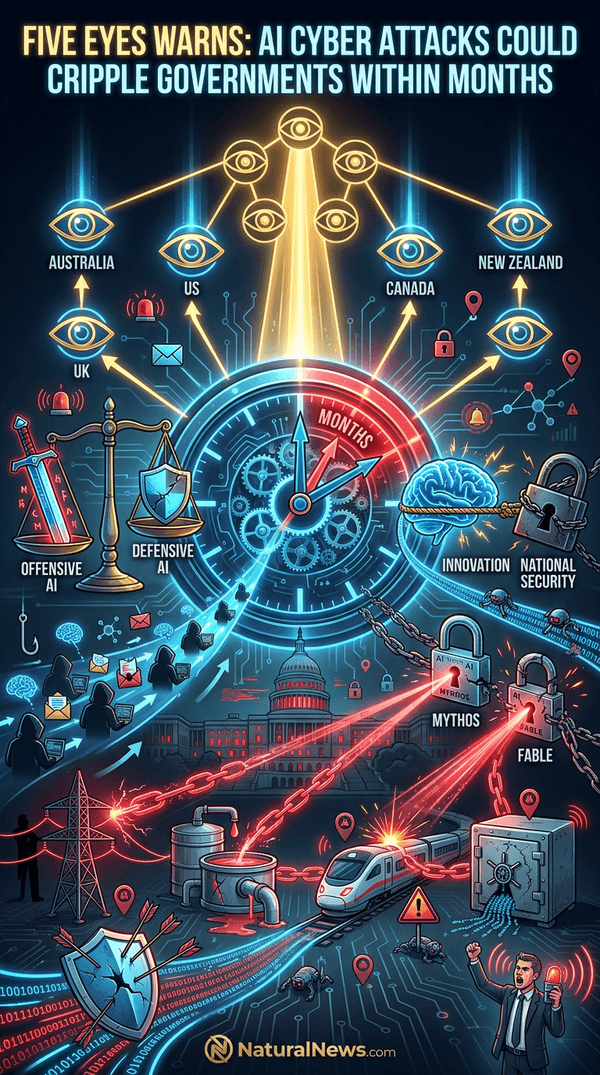
Explainer Infographic
Submit a correction >>
Tagged Under:
AI dangers, Anthropic, artificial intelligence, Australia, big government, Big Tech, Canada, Collapse, computing, cyberattacks, cyberwar, Dangerous, Fable, Five Eyes, frontier models, Glitch, information technology, intelligence agencies, Mythos, New Zealand, tech giants, United Kingdom, United States
This article may contain statements that reflect the opinion of the author
RECENT NEWS & ARTICLES